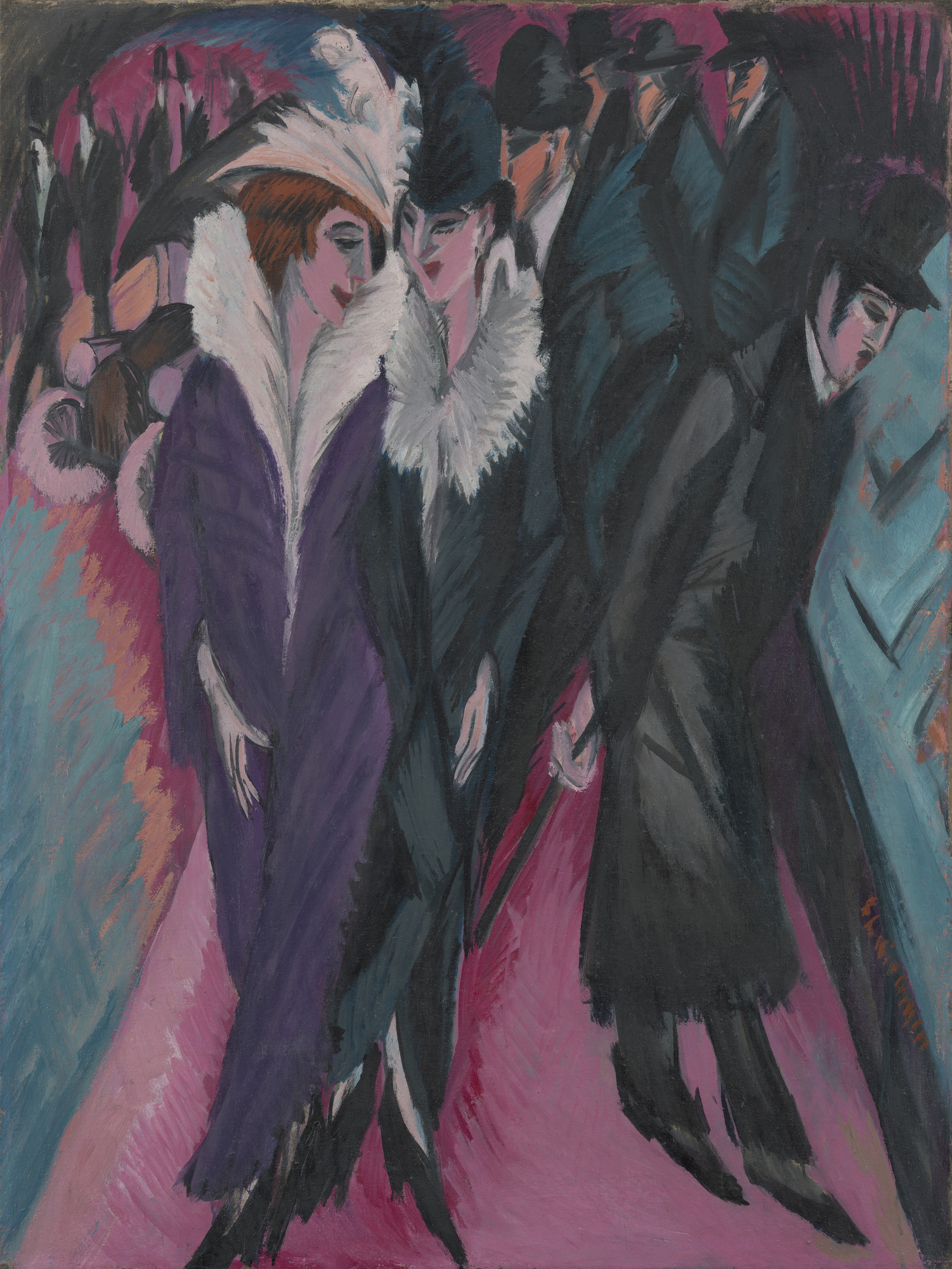
Narrator: In Street, Berlin, Ernst Ludwig Kirchner depicts two sex workers in the middle of a busy intersection. Here’s curator, Deborah Wye.
Curator, Deborah Wye: Kirchner chose these women as a kind of symbol of the modern city, a metaphor for modern life as the 20th century unfolded, so all the contradictions of modern life, the excitement and the dangers, the crowds and the hubbub, as well as the loneliness and alienation that people feel, all of that is really encompassed in the paintings themselves.
The women have a very kind of knowing, conspiratorial conversation going on between them. You might wonder, why are they out at night, so late, all dressed up, without any male companions anyway? I'm not sure that would have been considered proper in 1913.
Their steps are syncopated in a certain way, and their hips actually seem to sway in a certain motion. It's as if they're really trying to get attention. Even though, of course, the painting is static.
There are men lurking in the background, some of whom look as if they're about to approach the two women. A male figure to the right seems to be looking into a store window, but I feel suspicious of him. He's carrying a cane, and the cane is almost touching the women.
Narrator: Kirchner made this painting during a time of loneliness. He had recently moved from the relatively small city of Dresden to the bustling capital of Berlin. And the same year this was painted, the artist group he belonged to disbanded. Curator, Starr Figura.
Curator, Starr Figura: Kirchner used this really vibrant color as a way of emphasizing this sense of discord and anxiety in the way these very intense colors clash with one another. He's also tilted the composition and compressed it so that the perspective is collapsed. And that also enhances this sense of disequilibrium that we get when we look at it.