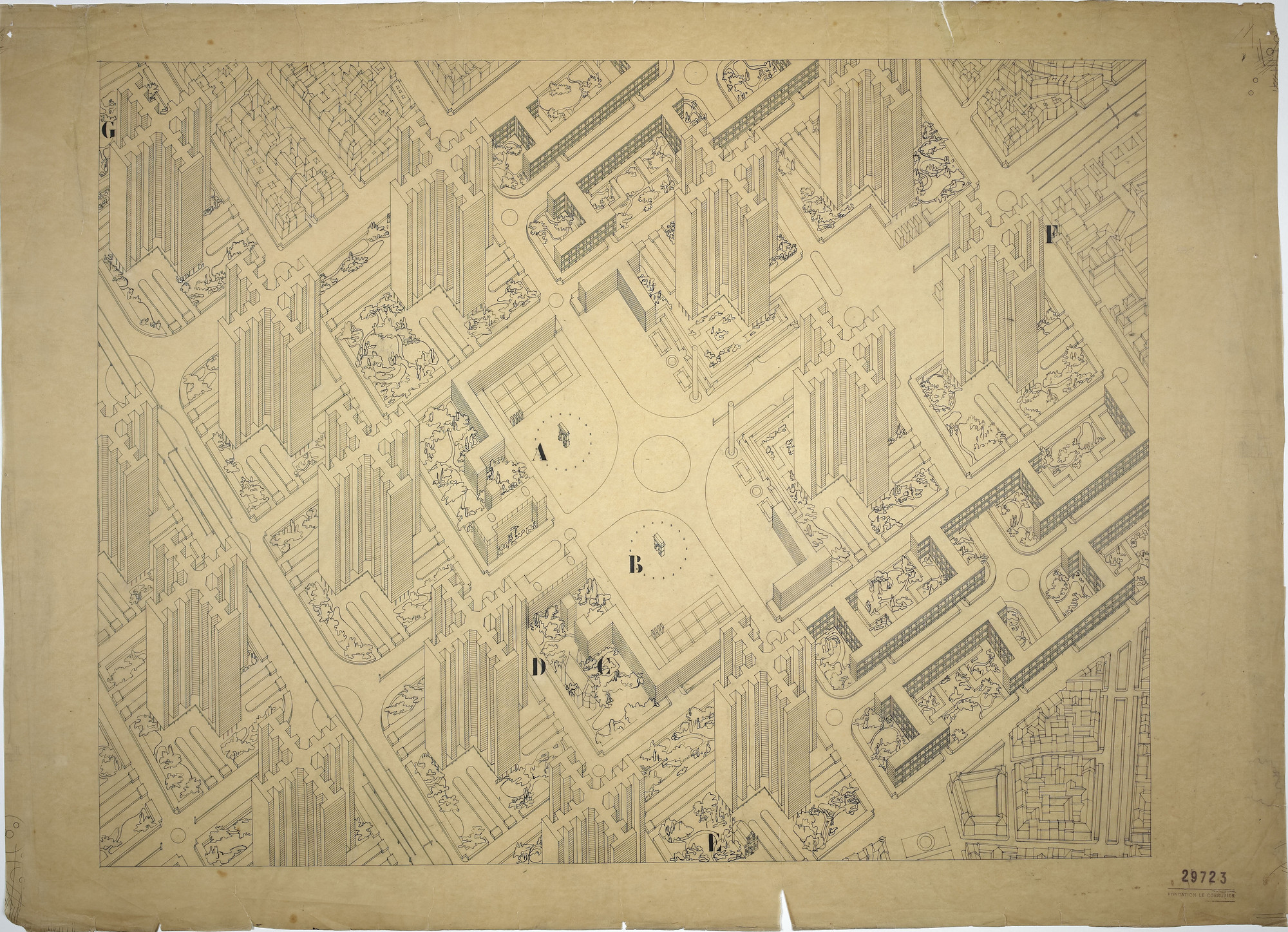
Architect, Jean-Louis Cohen: In the 1920s, Le Corbusier tries to seduce Paris. On one hand he builds villas for the elite; on the other side, he wants to present himself as the great reformer. As, someone who has bright ideas for the complete modernization of the city.
Curator, Barry Bergdoll: In 1925, Le Corbusier introduced his “Plan Voisin for Paris.”
Jean-Louis Cohen: The plan aims at the complete transformation of central Paris. Medieval buildings and 19th century buildings would be erased and replaced by a vertical city of glass office skyscrapers.
Barry Bergdoll: Le Corbusier likely did not intend to demolish whole areas of Paris. More polemical than anything else, his plan showcased his talent for self-promotion and self-invention.
Jean-Louis Cohen: Le Corbusier’s Voisin Plan of 1925 was an instant sensation in Paris and beyond—was published in all the architectural magazines, sometimes in the press. The Plan Voisin changed the public perception of Le Corbusier. He was no longer only a painter or the designer of interesting houses, /he became a public figure. And this public figure, the figure of the architect who comes out with solutions for the big city, would be his main persona for the decades to come.
Barry Bergdoll: The Plan Voisin was never built, but it influenced the future of other cities around the world.
Jean-Louis Cohen: For the better and the worse, the Plan Voisin is one of the sources of the big city environment we know today: completely eliminating housing, and creating specialized business centers. The ideal of the Plan Voisin can be found in the American downtowns.