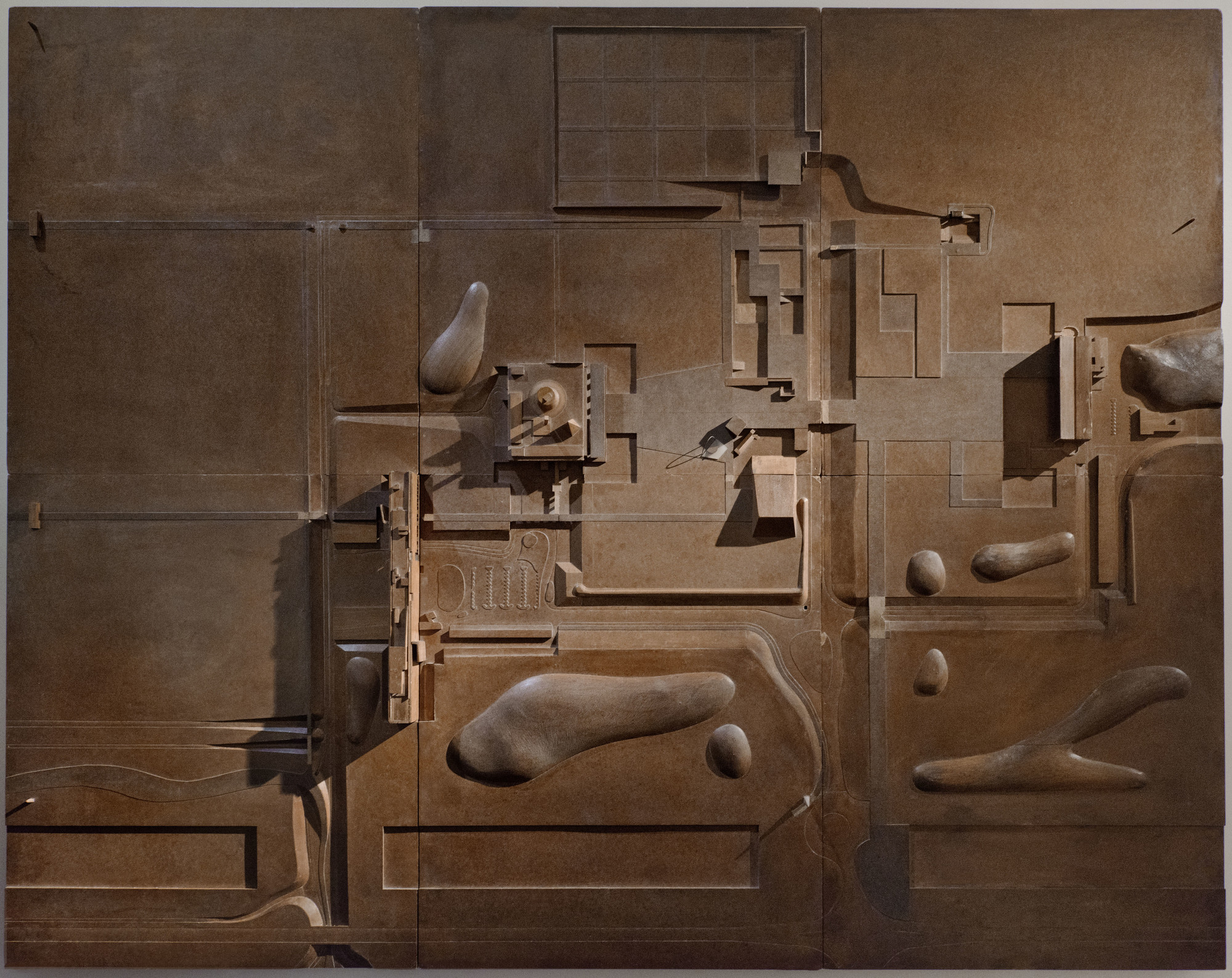
Curator, Barry Bergdoll: In 1951, Le Corbusier was invited to not only imagine an entire new city in India, but to build it as well. This is a model of the government center in the new capital of the Punjab, Chandigarh. It was one of Corbusier’s most successful urban experiments.
Architect, Jean-Louis Cohen: In Chandigarh, Le Corbusier met for the first time an extremely generous, public figure who commissioned him an entire city: the Prime Minister of India, Nehru, with whom he had a very close personal relationship. Nehru didn't want a city built after traditional Indian patterns, but wanted a radical new city. And he found in Le Corbusier a very useful instrument to achieve his goal.
Barry Bergdoll: Finally, Le Corbusier was able to build the city of his imagination. In this model we see the assembly building, the parliament, and the high court of justice.
Jean-Louis Cohen: In Chandigarh, the work of Le Corbusier derives from his observation of Indian landscapes, from the villages of Punjab, but also from Mughal gardens that he had visited in various cities. Chandigarh is also very interesting as an urban composition organized under the skyline of the Shivalik Mountains.
One could say that Chandigarh is sort of recapping the entire trajectory of Le Corbusier in respect to the design of cities. So Chandigarh is /the ultimate achievement of Le Corbusier in terms of urban composition.