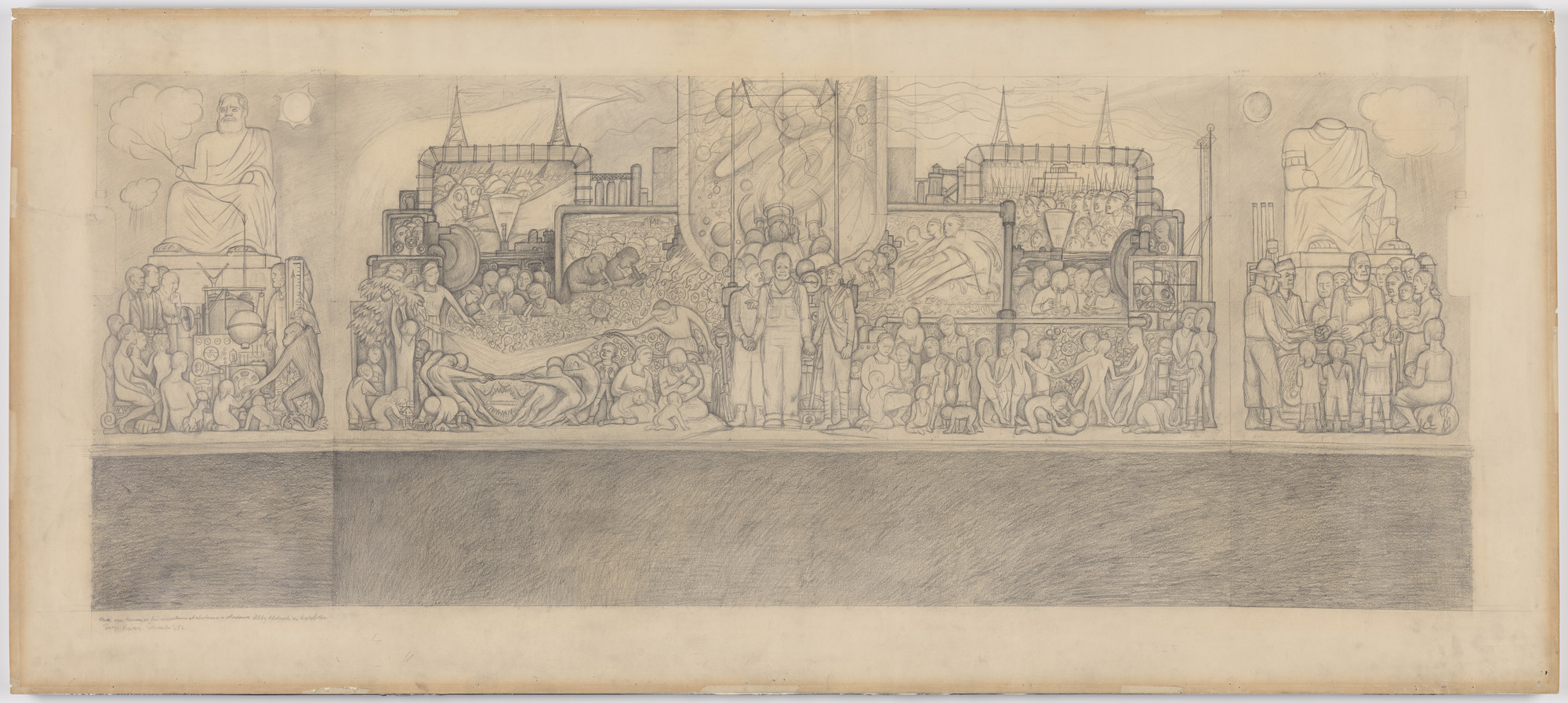
Curator, Leah Dickerman: While he was working on MoMA’s exhibition panels, Rivera began discussions about a mural commission in the new Rockefeller Center complex, with Abby Rockefeller and her son, Nelson.
What you see here is Rivera’s sketch that he submitted for approval in the hopes of gaining the Rockefeller Center commission.
One thing that’s worth noting, is that Rivera’s already mapping out the composition as an allegory between competing social systems, between Communism and capitalism. And on the Communist side, on the right, you can see that there are images of workers' procession and of fleet athletes lined up at the starting line; and on the right are images of warfare and soup lines.
As things progressed, he added an image of Vladimir Lenin that was based on a photograph that he asked his assistants to procure for him.
And when this image was noticed by Nelson Rockefeller, he wrote Rivera a letter asking him to change the image to that of an unknown man, and Rivera refused.
Rivera had been expelled from the Communist party in 1929 and he wasn’t going to back down in presenting his Communist credentials.
The Rockefeller family ultimately dismissed Rivera, paid him the rest of the fee, and covered the mural over in a tarp. There were demonstrations of workers and artists protesting the covering over of the mural, and a few months later the mural was cut out of the wall.