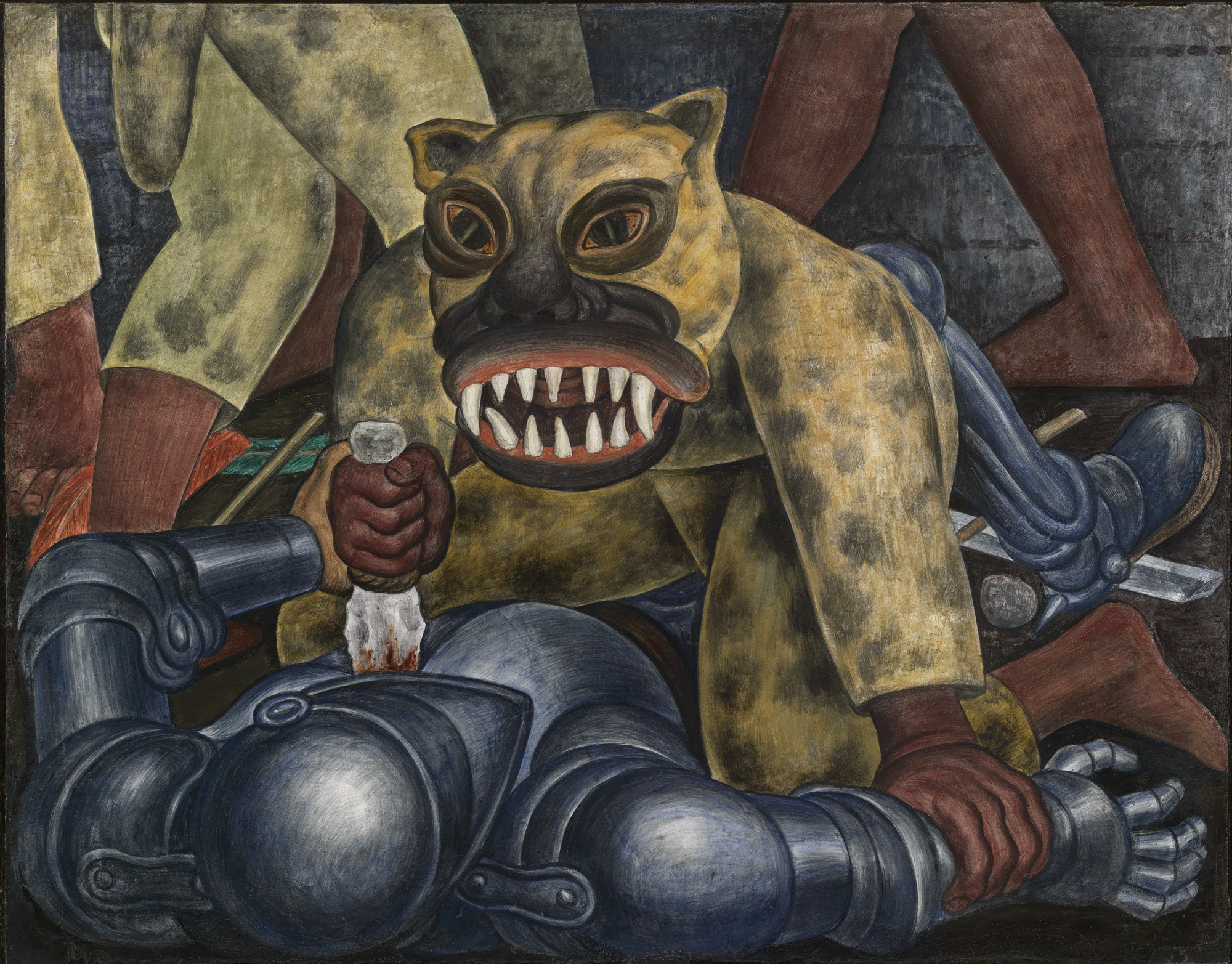
Curator, Leah Dickerman: Indian Warrior reaches back the furthest into Mexican history of all the MoMA exhibition panels. It isolates a detail from his fresco cycle at Cuernavaca.
The subject here is the conquest, that’s the Spanish subjugation of the lands inhabited by the indigenous pre-Colombian people. And here an Aztec warrior in a jaguar costume kills a conquistador, and the jaguar warrior is an elite Aztec military order. You would achieve it by taking as many prisoners as possible for human sacrifice. And the costume was thought to imbue the warrior with the power of the animal.
Looking at this fresco panel, you can see a human mouth through the teeth of the mask.
Here the jaguar warrior holds a stone blade, which he’s plunging into the heart of the Spanish armored conquistador. And on the right is the broken steel sword of the Spanish soldier. So there’s this contrast between the power of the Aztec stone knife and the broken steel of western culture.
The jaguar knight is an emblem of righteous rebellion, and it connects up with the mural of the agrarian leader Zapata, the famous revolutionary leader, so it’s offering a precedent embedded in indigenous pre-Colombian culture for the victory of the Mexican Revolution.