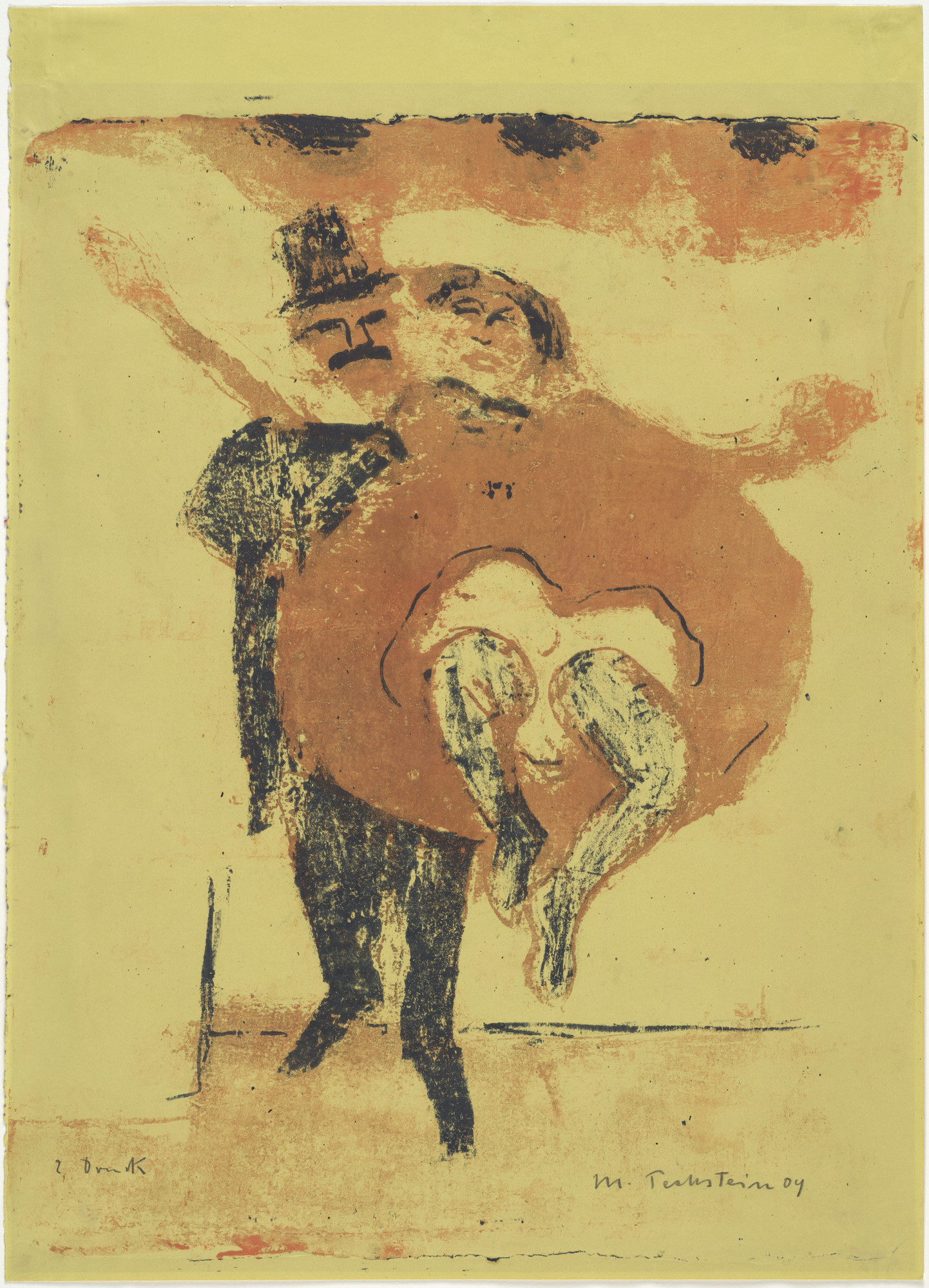
Director, Glenn Lowry: You’re looking at Dancers, by Max Pechstein, one of several artists who joined the Brücke group over the years. He made this in 1909 near the height of the group’s communal style.
Curator, Starr Figura: Dance was an extremely important subject for the Brücke artists. It represented a wonderfully uninhibited form of expression and communication. The type of dance that they were most attracted to was a very low brow sort of dance hall, called the Variétés. And they often focused on what was a little bit risqué, or sometimes even lewd, about these performances. As you see, her skirt is coming way up, and we can see her bloomers. He also printed the image on a bright yellow piece of paper. And that bright yellow, I think was meant to simulate the sort of lurid atmosphere of the nightclub.
What's also interesting is the way he made this lithograph. it almost verges on abstraction, the way the forms meld together, and her skirt and her arms almost look like brush strokes and blobs on the paper.
Lithographs are printed from polished limestones, and so these brushy areas are where Pechstein would have brushed on his design, and [would] actually wash it with a turpentine solution to lift up some of the particles, to make them smear and smudge, and even disintegrate. And that's what gives it this wonderful abstract quality.