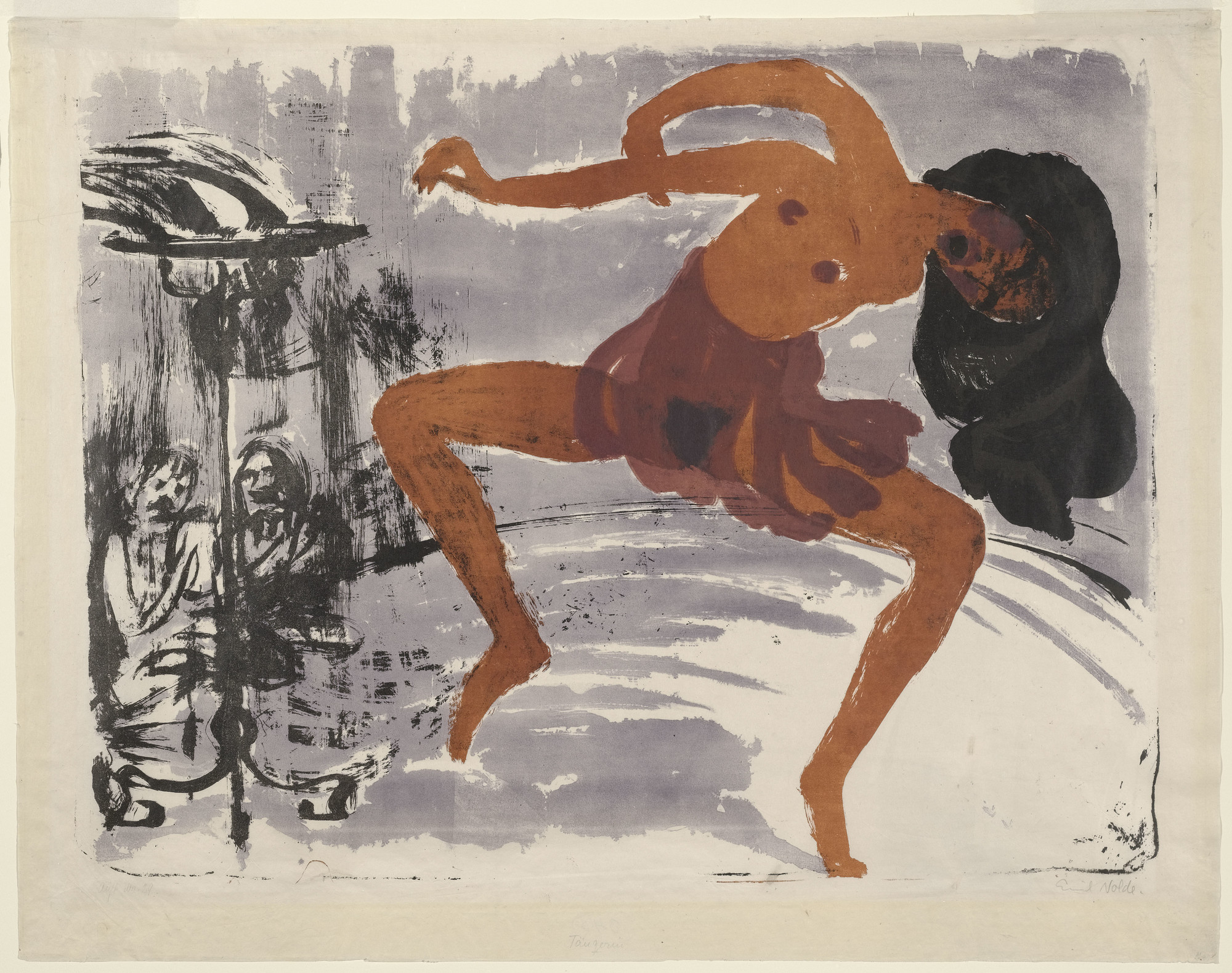
Curator, Starr Figura: This is Dancer by Emil Nolde from 1913. Nolde had briefly been a member of the Brücke group from about 1906 to 1907. He was an incredibly prolific and experimental printmaker, and this is one of his most exciting and dramatic printed works. You can see the colors have been brushed on in a very loose gestural way, which complements the free movement of the dancer.
With her flowing hair and her legs askew, and her arms fluttering, she really embodies everything that the Expressionists believed in unbridled emotion, spiritual freedom, and uninhibited joyful kind of eroticism. Nolde was very interested in modern dance. He was actually friendly with a number of experimental dancers at the time whose dances were based on really quick, dramatic poses, and a more minimal and expressive approach to bodily movement than other types of genteel dancing. Another influence in this particular work was his fascination with the tribal arts of Africa and Oceania, which he saw in the ethnographic museums.
It very much expresses his belief that those more remote cultures had a more authentic uncorrupted means of expression, in contrast to European culture, which by then he felt was overly refined.