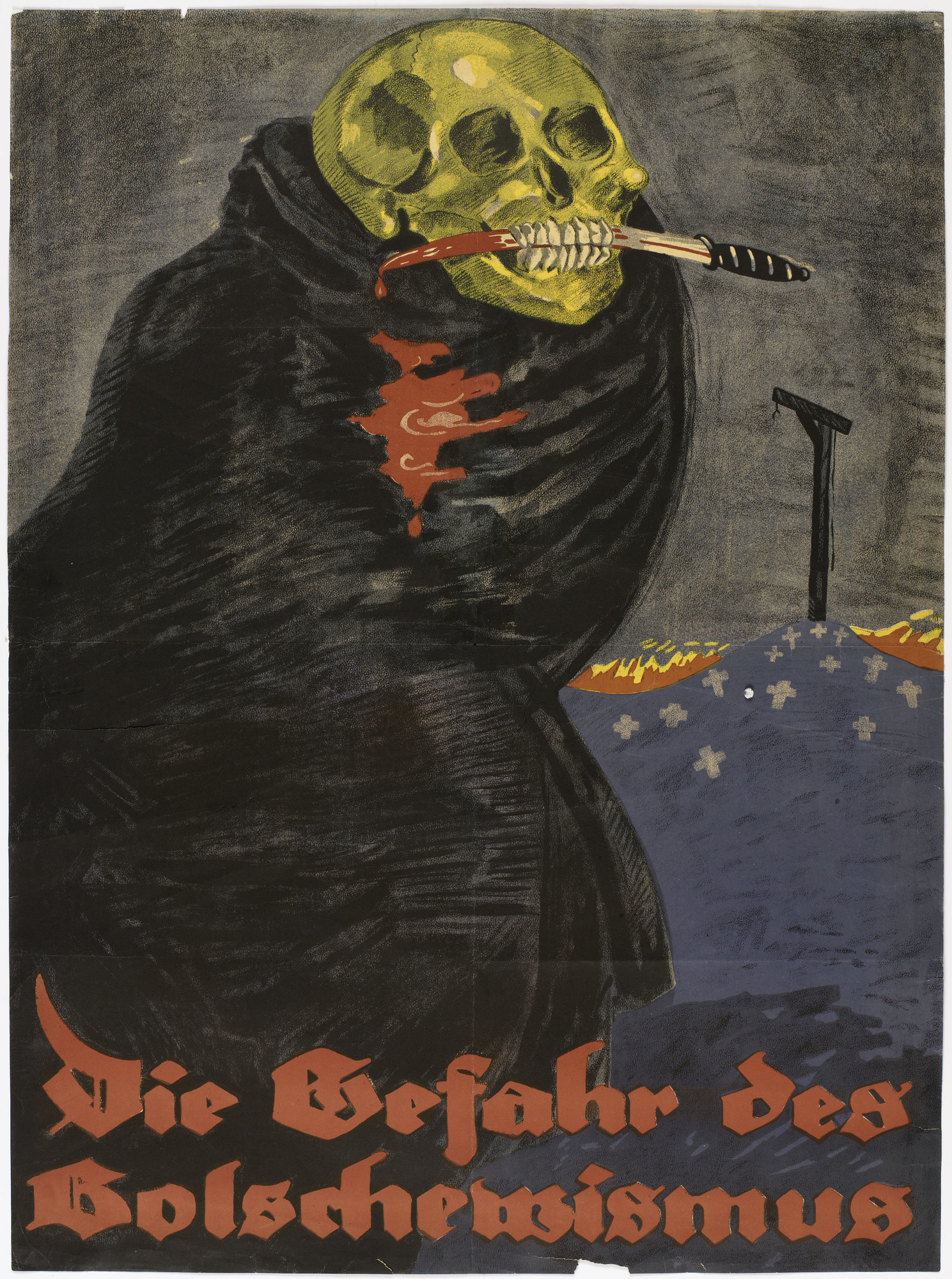
Director, Glenn Lowry: After the war ended, a new democratic republic was proclaimed. But optimism faded quickly in the Weimar Republic. Food shortages persisted as did inflation and unemployment. In the midst of this volatile atmosphere, many feared that the revolution that recently brought the Bolsheviks to power in Russia might be replicated in Germany.
Curator, Starr Figura: This is a poster called The Danger of Bolshevism, by Rudi Feld, from 1919. It was created as a anti-Bolshevik poster. And so you see a death figure, really terrifying, like a horror movie kind of figure, with a bloody knife in his mouth, and behind him in the distance, a landscape on fire with grave markers. So the message is that Bolshevism will bring death and destruction. The artist, was a young graphic designer at that time. He's not really that well known but what this demonstrates is how that sort of jarring, intensely colored, highly provocative type of Expressionist image was appropriated by various artists at this time coming from all different backgrounds and ideologies.
As you'll see on this wall, it's one of many posters that were done as a way of trying to encourage people not to go on strike, to keep working, to keep being responsible, so that this very difficult and tumultuous situation would not tip over into anarchy.