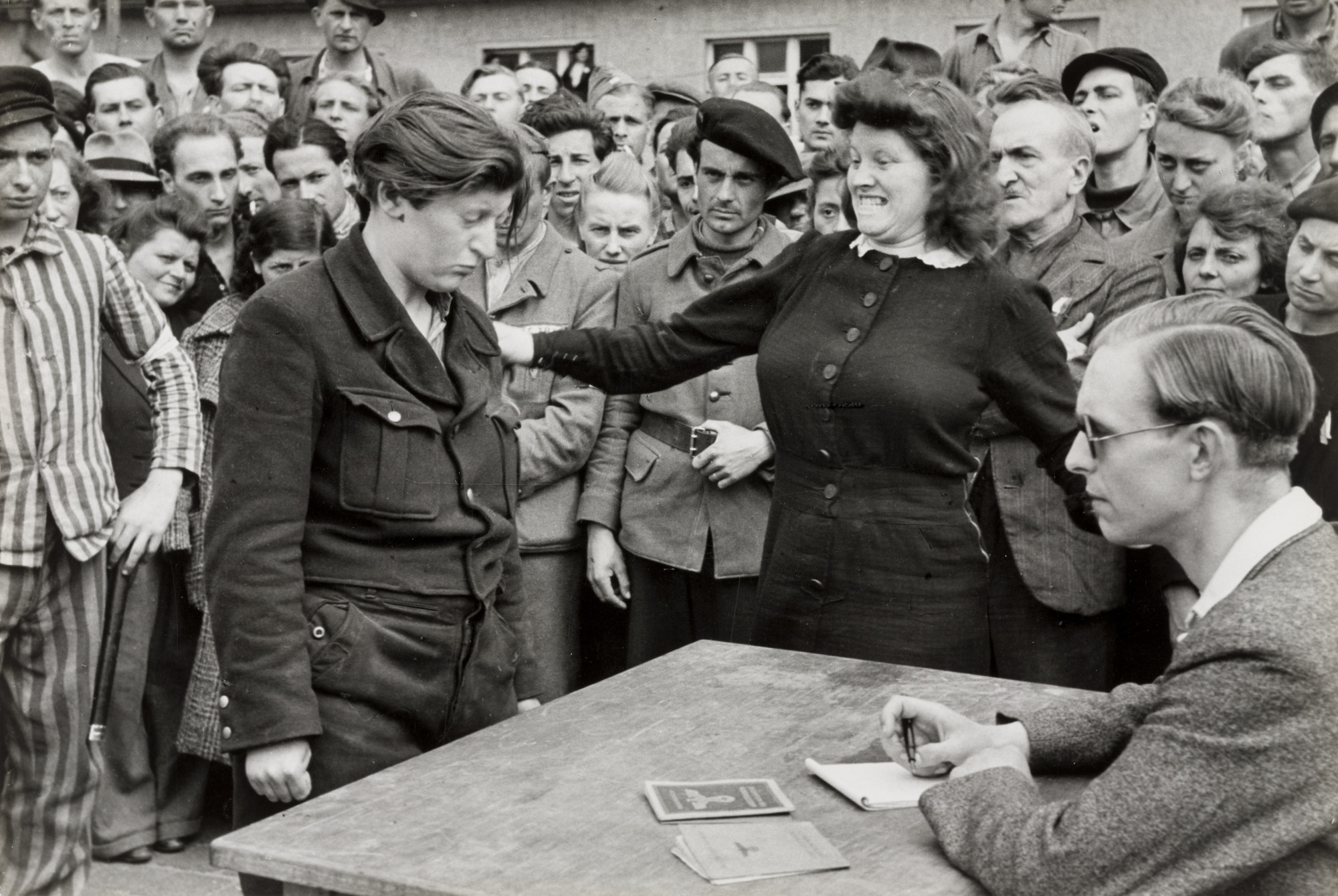
Director, Glenn Lowry: Cartier-Bresson was marvelous at discovering mystery in utterly ordinary things. But as a photojournalist after World War II, his style completely changes. Instead of mystery, he made photographs that were clear and comprehensive—and tell the whole story. This picture made in Dessau in 1945 is a wonderful example of that.
Curator, Peter Galassi: Cartier-Bresson had been a prisoner of war in Germany for nearly three years. He tried to escape two times, and then on the third time was successful. And partly because of that experience he was commissioned by the US Office of War Information to make a film about the return of displaced persons and prisoners of war.
And this incident appears in the film. The cameraman is filming this scene, and Cartier-Bresson, is right next to him making his own pictures. This is at a displaced person's camp. And the woman in the black dress had been denounced to the Gestapo by the woman she's about to hit. And here they're both telling their stories to the man on the right who's obviously the man in authority.
And what's typical in this picture of Cartier-Bresson's best work after the war, is that it's all boiled down to these three protagonists. The anger of the woman who had been betrayed totally saturates her body, just the way the shame and the guilt of the woman who had done the betraying occupies her body, right down to where she's got her thumb inside her fist.