Curator, Sarah Suzuki: Rosemary Trockel came of age in the '80s in a very male-dominated German art world. And since that time, she's always been very interested in the role that women play in the art world and in the world in general.
Director, Glenn Lowry: These prints relate to a series of large scale knitted pieces Trockel began in the 1980s.
Sarah Suzuki: So if we start by looking at the one that's made of loops, this is the one that I think connects most directly to her knitting paintings. They really have that interwoven, inter-knottedness. But one of the things that I think is interesting about this is it has both kind of this anonymity, this endlessly repeating loop, loop, loop, loop, loop. But at the same time, it seems very personal. It's very expressionistic. And it's obviously a very clearly hand-done kind of loop, loop, loop.
When you go to the middle image, which I think, more clearly references a rigid grid. But of course, as you look closely, it's easy to see that it's not completely perfect in its abstraction, that it very clearly was done by hand. And, Trockel herself has said that, when she thinks of geometry like this, it’s everyday applications whether it's bathroom tile or kitchen tile, or a pattern on a tea towel, or something like that.
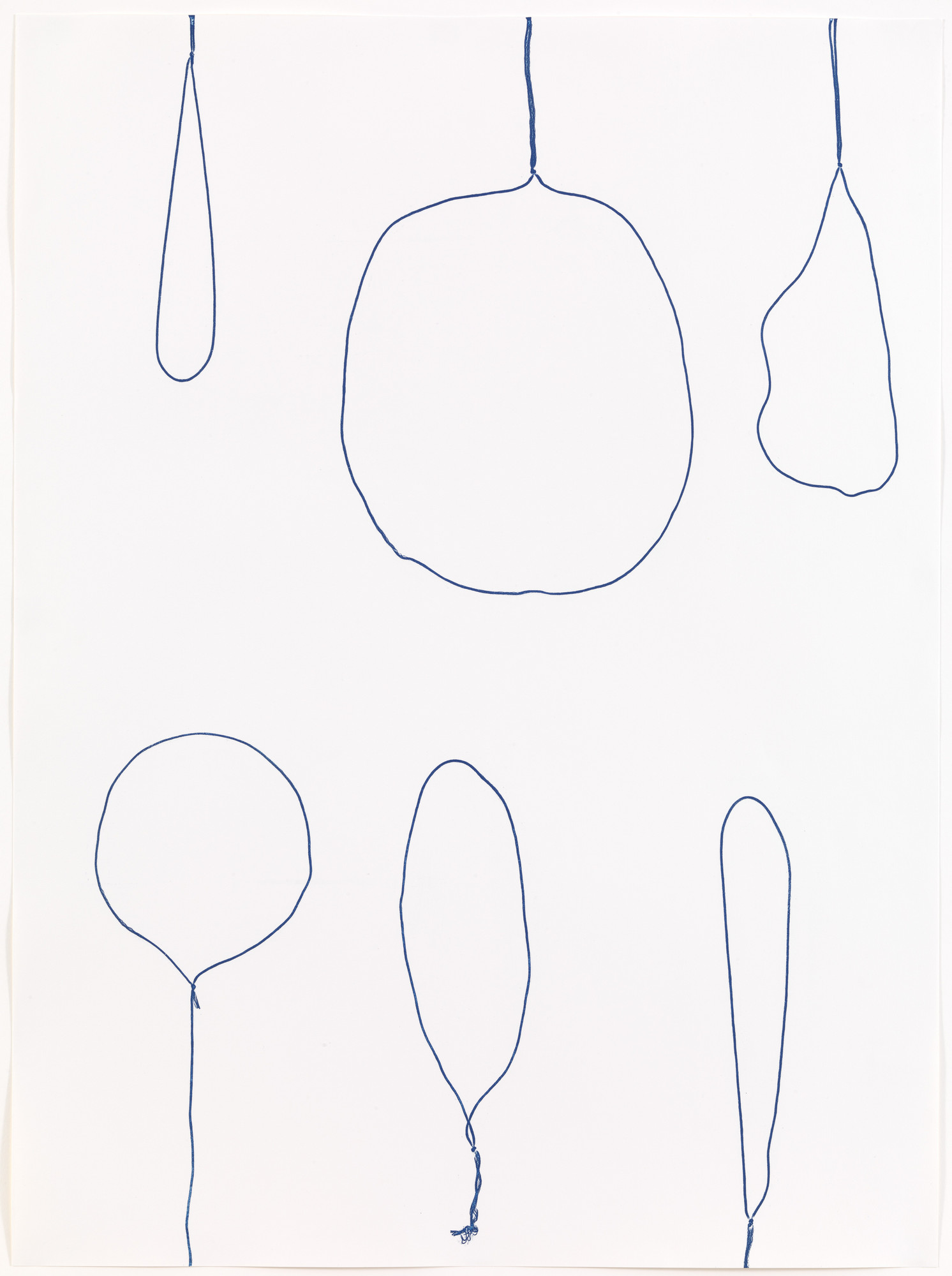
The third image, with those big loops, is much more enigmatic. The three loops coming from the bottom, to me, almost look like children's drawings of balloons, whereas, the three from the top, which are in many ways, very similarly shaped, look like nooses.
So, what she did was, she had these very large etching plates. And they were prepared in a certain way, so that when you press directly on the plate, whether it's with your thumb or with a pencil, the plate will take that impression.
So what she did in this instance was actually to use yarn. And so, she would loop the yarn directly onto the plate, over and over and over, and press them directly on the plate. When you lift the yarn up, the impression of the yarn is left, and you can ink that and print it directly.