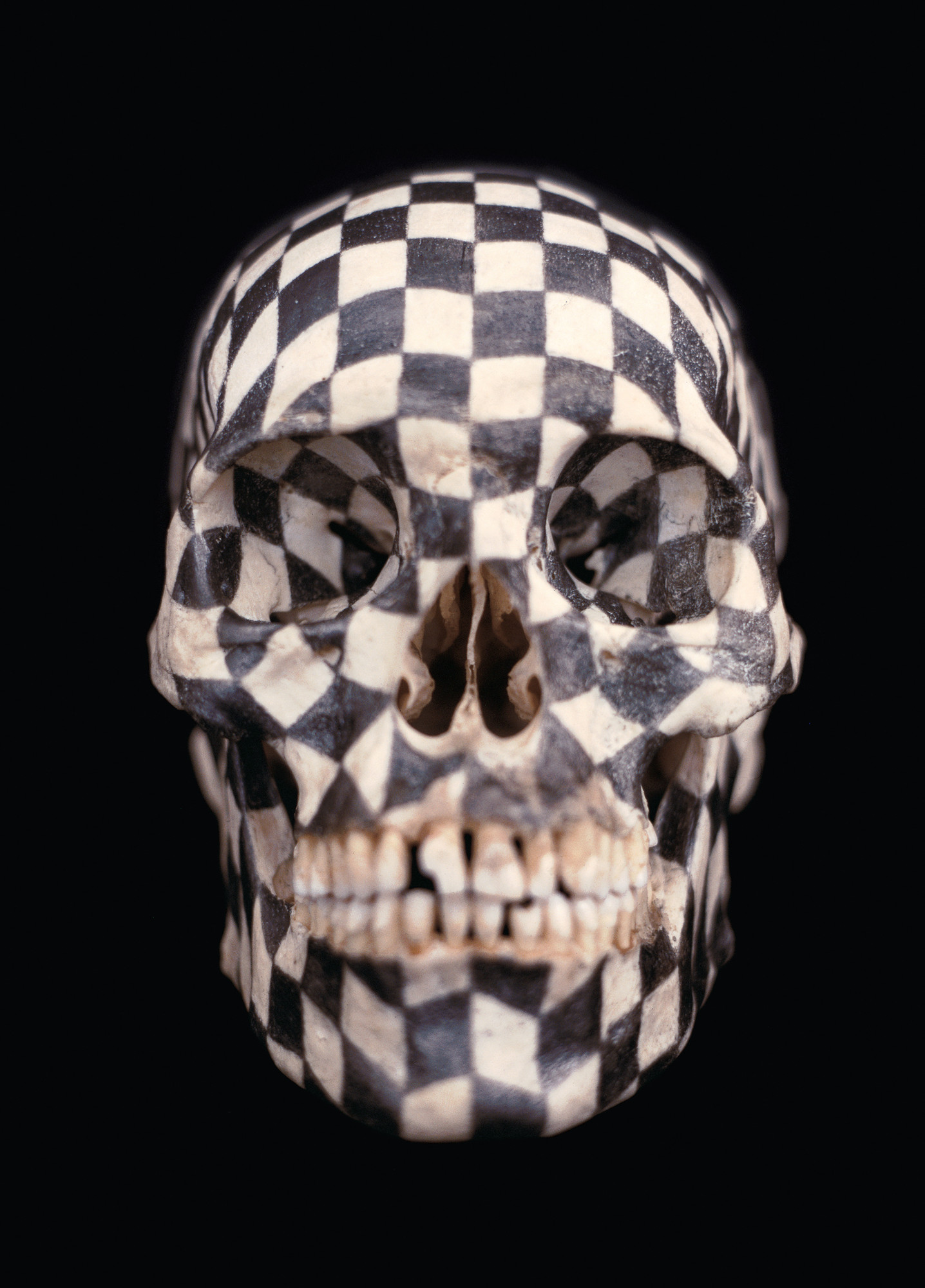
Curator Ann Temkin: Black Kites is a work which Orozco himself has, called with marvelous word play, a skullture, S-K-U-L-L-ture.
Orozco made this during a several month spell at home, in his apartment on Washington Square. And he was home, because, he had had a collapsed lung, which obviously kept him from doing the travel that had dominated the last five years of his life.
Artist, Gabriel Orozco: The making of Black Kites was an intense experience because it’s a real skull. It’s not a plastic one. So, to be drawing on that, over a period of several weeks, carefully, doing this very methodical drawing was a very intense experience. And I think I wanted to do it slower on purpose. I really wanted to have that experience to be alone with this head.
A lot of my work has to do with time. Some of my work is a gesture that is obviously made in a moment. Some other works are very elaborate, and they take longer. For me, that is very important how the time of perception, the time of making, the timing of awareness is very important. So I think Black Kites has that concentration of time in an object that is not very big, but is very powerful.
Ann Temkin: And this has remained, one of the most uncannily powerful works, I think, of the 1990s, in that he’s combining abstract art and something which is, in this case— through the medium of being about death, you know—so much about life, and about man, and about existence.