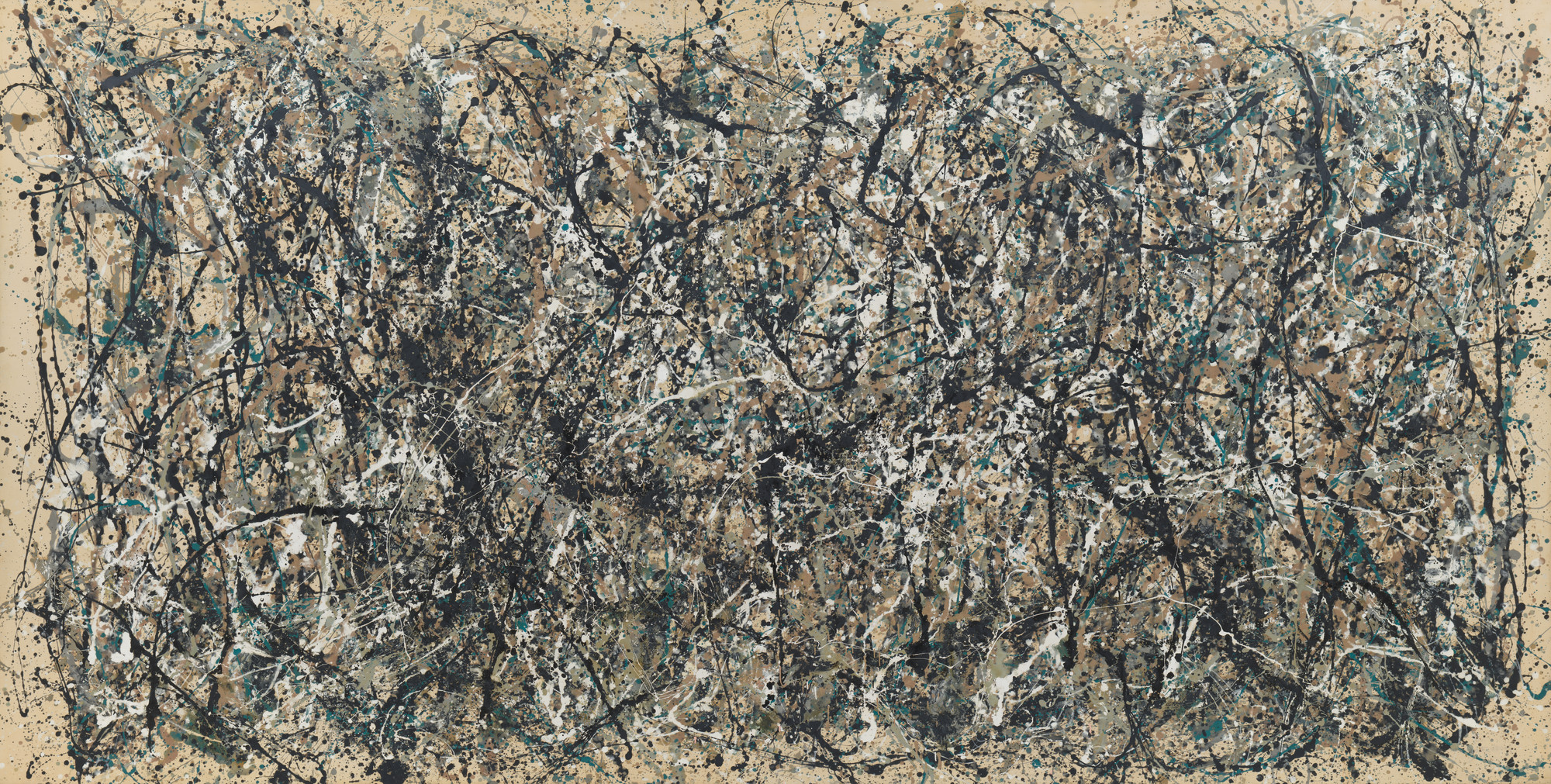
Narrator: The artist Jackson Pollock made One: Number 31, 1950 in 1950, using oil and enamel paint on canvas. The painting measures eight feet, 10 inches high and 17 feet, six inches wide. In metric units, it is about 270 centimeters high and 531 centimeters wide.
This vast, wall-sized composition is one of Jackson Pollock’s largest “drip” paintings, a term describing the technique that came to exemplify his approach to Abstract Expressionism. To make it, the artist laid the canvas flat on the floor of his barn studio then dripped, poured, and splattered enamel house paint onto the surface. Pollock’s gestures created ribbons of color that intersect to form intricate and energetic webs of paint. “On the floor,” Pollock said, “I am more at ease. I feel nearer, more a part of the painting since this way I can walk around it, work from the four sides and literally be in the painting.”
The cream-colored canvas is covered almost edge to edge with densely layered drips of gray, olive green, teal, black, white, and brown. At the center, a thick tangle of paint makes it difficult to tell where one drip begins and another ends. The most prominent marks are in black and white. They dance across the surface in overlapping drips, arcs and erratic loops. Some loops are enormous. The ribbons of paint vary in length and width since they have been dribbled and flung. Some of the paint has absorbed into the canvas. But many of Pollock’s drips have built up a glossy, textured surface.
Beneath these strands of black and white paint, splashes of teal and grayish green spray across the canvas. The gray has a different character from the rest of the paint. It does not appear as dribbles and lines, but rather as broad pools and stains.
Throughout the dense web of line and color, we get glimpses of the raw, cream-colored canvas beneath. Most of the drips and looping lines end a few inches short of the painting’s edges, leaving a border of canvas visible around the perimeter of the painting.
Now let’s hear more about this work from a curator.
Curator, Ann Temkin: Jackson Pollock is best known for what we have come to call his drip paintings. And drip is probably not so fair a name for them because a lot more is going on here than simply holding a can of paint and dripping it down on to a canvas.
He had made, for many years, paintings on easels in a kind of conventional way with brushes and oil paints. And then, around the year 1947, he decided that he was going to approach his work in an entirely new way. And decided that he would paint with canvases unstretched, laid out on the floor. He would actually move his body around, above them, over them, working with paint that was in cans. And with sticks or with stiffened paint brushes, he would less drip than probably fling the paint from the cans onto the canvas with what is actually, we now recognize, an enormous amount of control. Because if you look at the way these various lines of paint skate all over the canvas, you realize the degree to which there is some kind of incredible calculation of when the paint gets thinner and thicker and lighter and heavier and faster and slower.
This was a very physical kind of painting. It wasn't a painting that one could do sitting down, or that one did without a tremendous expenditure of energy. And that energy actually is transferred on to the canvas in a way that's very direct and immediate.