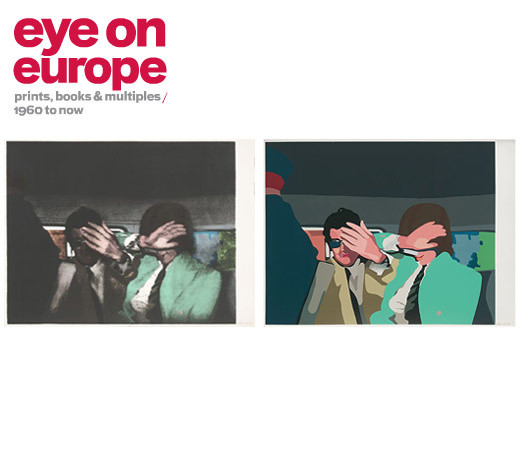
DEBBY WYE: This work by Richard Hamilton and the one just to the right are screenprints. Screenprint is a kind of stencil technique that was used almost exclusively for commercial projects before the 1960s. But since it can easily reproduce photographs and create rich, saturated color, it was adopted by Pop artists like Hamilton.
WENDY WEITMAN: Both prints are based on the same London newspaper image from the late 1960s. Here’s Mick Jagger and Hamilton's art dealer, Robert Fraser, hand-cuffed together in the back of a police van, attempting to shield themselves from the paparazzi after being arrested on drug possession. Hamilton made the work on the left, Release, as a benefit for an organization of the same name that provided legal aid for people in trouble with the law.
DEBBY WYE: In screenprinting, a different screen is used for each color, and by varying the screens and colors, Hamilton has achieved different effects. Release is grainy, dark and somber, conveying the frightening aspects of being arrested.
By contrast, the print at the right captures the excitement of celebrity with its dazzling brightness.
WENDY WEITMAN: It’s tempting to read the title of that print as Swinging London. But it’s spelled with an “e” -- Swingeing London -- and that’s intentional. In the British idiom, "Swingeing" means “to lash” or “hit something hard." At Fraser’s trial, the judge reportedly said to him: "There are times when a swingeing sentence can act as a deterrent."