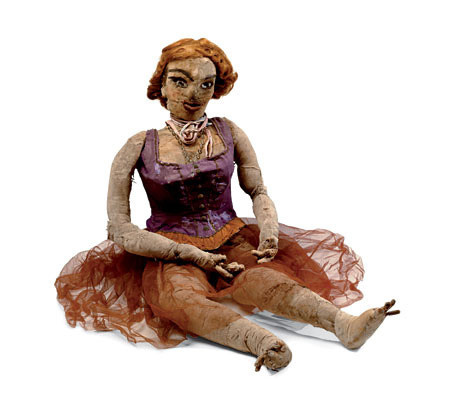
John Elderfield: In the 1930s, as Reverón started to attract more attention, photographers came to El Castillete and eventually filmmakers came. And really it’s from these accounts that we start to see the existence of his dolls, which Reverón and Juanita Ríos, his companion, presumably created together. It’s almost as if that now that the paintings are starting to have a life outside his control, he is creating things which are for himself.
As he was doing figure compositions, it was just more convenient to have the dolls to work from. But it’s also clear that the dolls were treated as sort of quasi-real people. There was one room which was actually designed as a little bar for the dolls. And they sat around, arranged, as if they were having tea.
Surrogate figures of this kind are so ubiquitous in contemporary art. They relate to fetishes and feminization, pornography, all sorts of issues. But we have to be careful not to look at these with modern eyes. The dolls were not made as sculptures. And they were made in a culture very, very different from our own.
Reverón was deeply, albeit eccentrically, religious, and so he was aware of the Santos, the images of saints. He was also aware of the use of surrogate figures within the cultures of Latin America. And I think there is an argument to be made for the sort of strange innocence of all this. We know that he nearly died when he was young, and when he recovered he played with dolls.
Reverón clearly has retreated into some kind of childhood world. The dolls are the people who he deals with because he doesn’t want to deal with the world outside. It is scary. But it’s one of those things that one takes as one finds it.