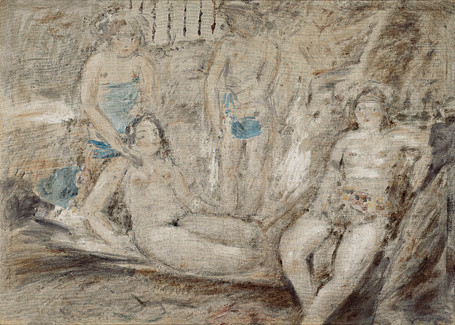
John Elderfield: In the late 1930s, in paintings like this Five Figures, one wonders whether the figures are truly human. The one at the back in particular could actually be a life-size doll hanging down the center of the composition. There’s a blur between the animate and the inanimate. One just doesn’t know. And this quality of the uncanny—you can’t tell whether something is living or not living—is part of the mystery of these pictures.
Look at the central woman, who you think is a doll. To the right of that doll is what seems to be a male figure painting on a canvas—at an angle in the upper right of the picture. Is this Reverón?
Even more bizarrely, I think, in the middle of the right edge of the picture, there is what looks like a head of a figure in grey. And if this indeed is a figure—and perhaps it’s a little doll—this picture really should be called Six Figures.
It’s tempting to think of one very divided production—the paintings, which were sold, and then the objects and the dolls, which weren’t. But where the landscapes were about shifting identities in terms of vision, these figure paintings shift identifies in terms of subject matter.