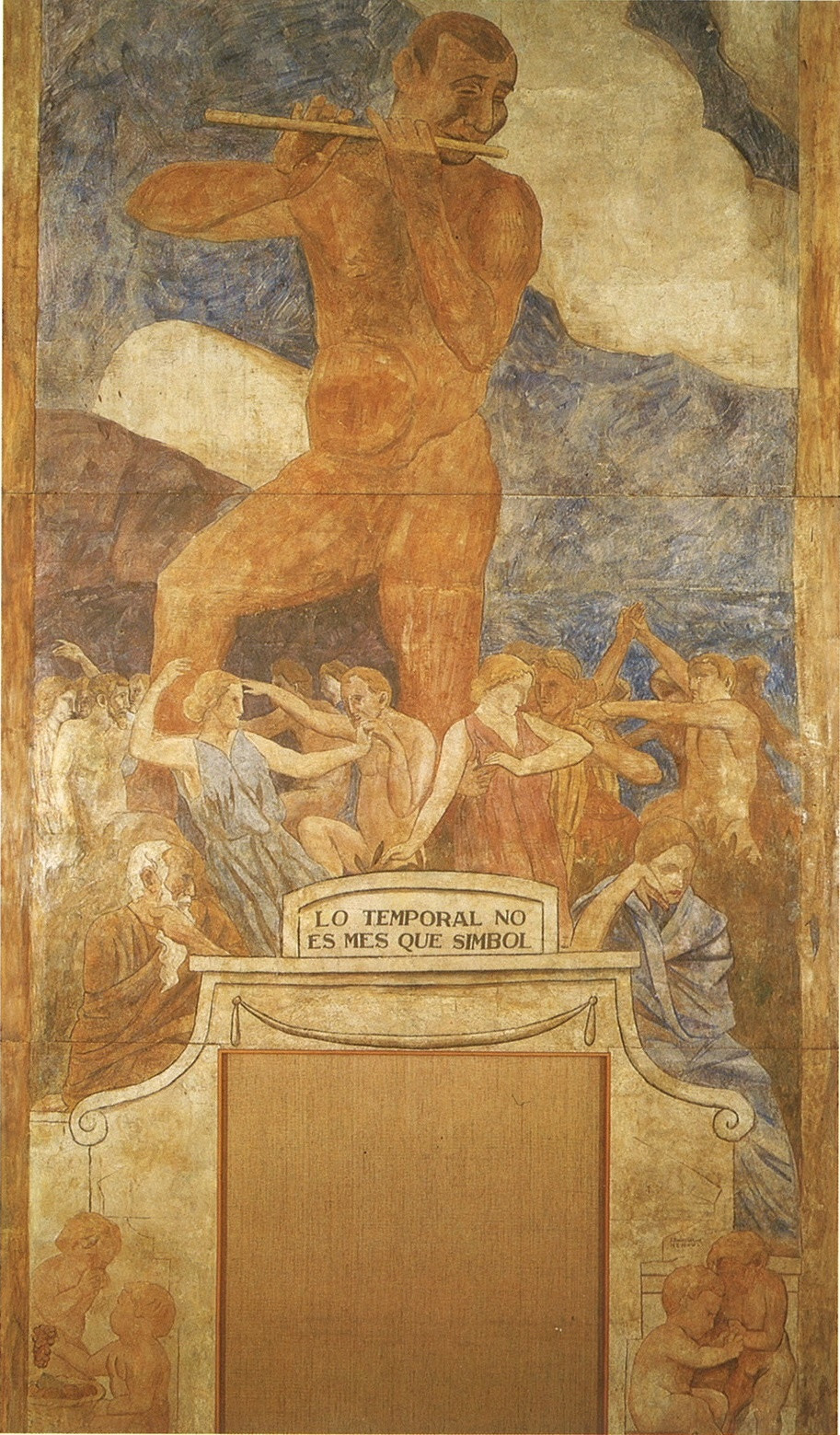
Narrator: Torres-García received a commission in 1912 to paint a series of frescos in Barcelona’s Palau de la Generalitat, the seat of the Catalan government. This panel, titled The temporal is no more than symbol, was the last fresco of the commission that he completed. Curator Luis Pérez-Oramas:
Luis Pérez-Oramas: It’s this representation of a humongous figure, a flute player, an ancient god similar to Pan that seems to awake souls or bodies that has been sleeping. In that sense, the figure seems to come from a timeless moment.
Narrator: The flute player’s music is also a metaphor.
Luis Pérez-Oramas: Music is also a representation of harmony. Of good government, too. So this goodwill musician commands humanity in a way good government should command humanity and awake humanity towards its best productions.
Narrator: The enigmatic title suggests that time is not a linear phenomenon.
Luis Pérez-Oramas: For Torres-García, time is just a human invention. This is important, because for the rest of his work, he would be convinced that what lays under significant symbolic production is something that is ageless, but that has, at any given time, a specific manifestation.
Narrator: The commission was cancelled when Enric Prat de la Riba, leader of the Catalan nationalist government, which sought independence from Spain, died in 1917.