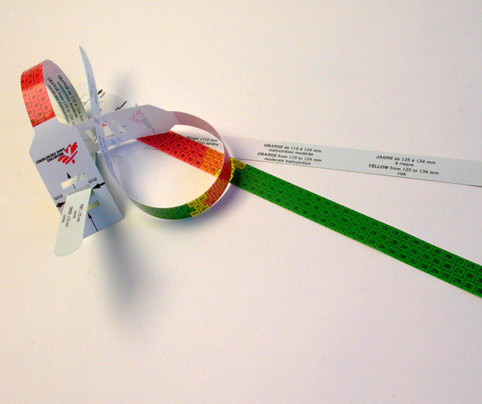
Curator, Paola Antonelli This strip of plastic, as you might see, is marked with different colors. When it is fitted on the upper arm circumference of a child, it measures the level of malnourishment, of malnutrition of the child, therefore informing the doctor of the kind of emergency nourishment that the child needs.
You might ask, why is it necessary to measure in such an objective way the evident malnutrition of a child that can be noticed immediately by just looking at the child himself? The fact is, when you, as an emergency aid worker, have in front of you not one or two, but dozens, hundreds of malnourished children, you need to know as soon as possible who has what kind of malnutrition. Depending on the degree of malnutrition, a child might need a particular compound of minerals, salt and nutrients, or another. It's very important for the doctors to know right away, so that they can give the right packaged food to the child immediately.
The first time that the bracelet was implemented in a very large scale was in 1998 during the devastating famine in Sudan. The implementation of this bracelet has helped save many lives.