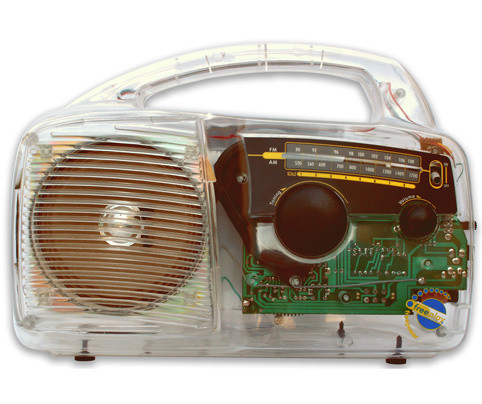
DIRECTOR, GLENN LOWRY: The Freeplay Human Powered Radio is designed for people who have no access to electricity. That’s as much as a fifth of the world’s population. The radio is powered by a solar cell or by turning a handcrank in the back that winds an internal spring.
[SFX: winding in clear, then under next paragraph]
A good winding will keep it playing for a half hour.
Cameron Sinclair is the founder of Architecture for Humanity, a non-profit organization that provides design services for communities in developing countries.
CAMERON SINCLAIR: I actually bought one of these radios back in 1999, when I was in South Africa looking at a number of projects. In August 2003, New York was hit by a blackout. While most people were worrying about what to do, I simply grabbed the radio and wound it up, and I sat on the stoop of my building and, you know, with coffee in one hand and radio in the other, suddenly a group gathered there was 40, 50 people sitting around this radio.
What's fascinating about this is that here you have a product that was developed for the developing world, but here we are, sitting in the middle of New York City, and there's a group of people listening intently to try and find out information of what's going on.
GLENN LOWRY: The Freeplay Radio was conceived in 1994 by British designer Trevor Bayliss. Two versions are now manufactured in South Africa. Profits from sales of a more elaborate commercial model subsidize free distribution of a simpler nonprofit model in developing countries. Some 300,000 have already been distributed in sub-Saharan Africa.