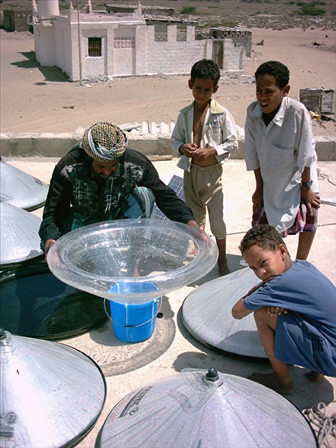
Curator, Paola Antonelli In some parts of the world, fresh water can be a craving, a need that is not adequately fulfilled. You see here three representations of the extreme need for water.
The Water Cone is a very simple polycarbonate plastic cone with a circular lip at its base that collects water that evaporates, and enables people to drink it. It's for places on earth where there’s droughts, or where water is very rare. By evaporation, water gets somewhat purified so it's very useful in areas of the world where the only water present is salted.
I'd like to draw your attention now to this beautiful terra cotta jar—very traditional in its shape, and very important to the population of Bangladesh. It's a filter that uses clay, that uses carbon, some of the oldest ways to filter water. This particular very low tech, very simple system filters much of the arsenic out of the water, therefore making it drinkable.
The Safe Sari, is not truly a new invention, but a new use for a very old object. It is a way to educate the population to use whatever textiles they have at hand, folded many times, as natural filters—perhaps not perfect filters, but the beginning toward the purification of water. A textile filter, even if it's really thick, can not filter out everything, but it can be enough to filter some of the biggest bacteria, for instance the bacterium of cholera.