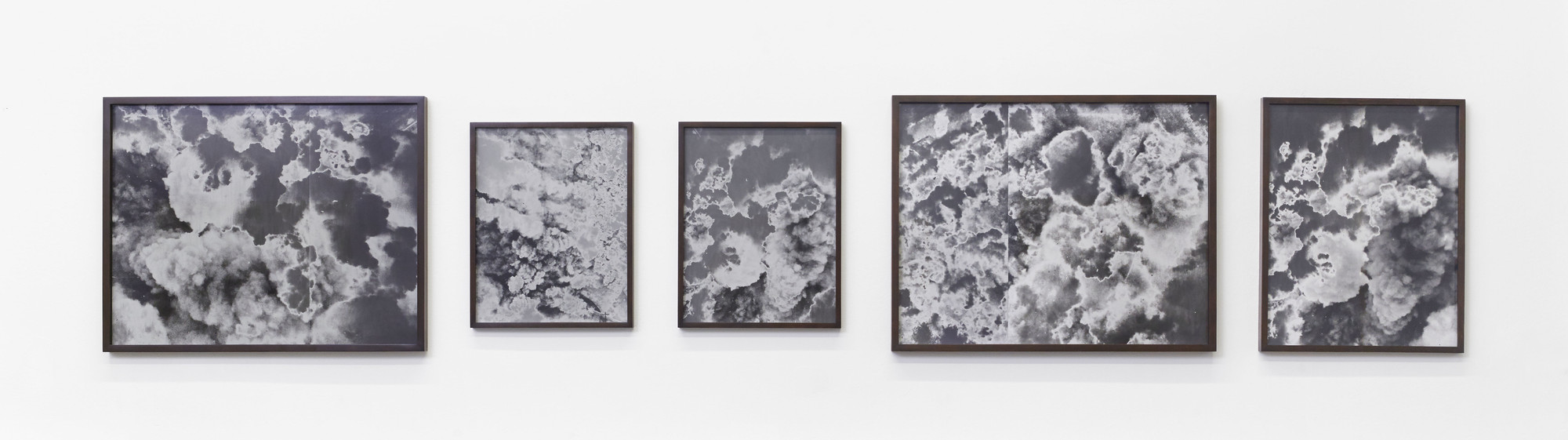
Artist, Lisa Oppenheim: Hello, my name is Lisa Oppenheim. I want to start talking about the suite of five photographs titled A Handley Page Halifax of No. 4 Group Flies Over the Suburbs of Caen, France, During a Major Daylight Raid to Assist the Normandy Land Battle. 467 Aircraft Took Part in the Attack, Which Was Originally Intended to Have Bombed German Strongpoints North of Caen, But the Bombing Area Was Eventually Shifted Nearer the City Because of the Proximity of Allied Troops to the Original Targets. The Resulting Bombing Devastated the Northern Suburbs, 1944/2012.
The reason why this piece has such a long title is that it's from a suite of images that I found in the Imperial War Museum in London. I made large-scale negatives of images of smoke from this battle, and then I exposed the images of smoke—which were aerial photographs—with fire light.
The bombs blowing off obviously contain fire that you can't see, but then the fire is reintroduced in the darkroom as the agent of exposure. It really looks more almost like an abstract depiction of something rather than a documentation of something.
1944 is the date that the picture was first made, and 2012 is when I made the image. Putting the dates in the title really points to the time element that's always present in photography but sometimes overlooked.
I think it's also important to note that I made them in Germany. I was living in Berlin at the time and making these images from the Second World War. Maybe it wouldn't have quite the same resonance for me personally had I not been in Germany.
Something that really interests me is collapsing this distinction between what's represented in the image and how they're made. What I really want to do by doing these very process-based works is point to the way in which any viewer is really constantly processing this information and these images in their own way.