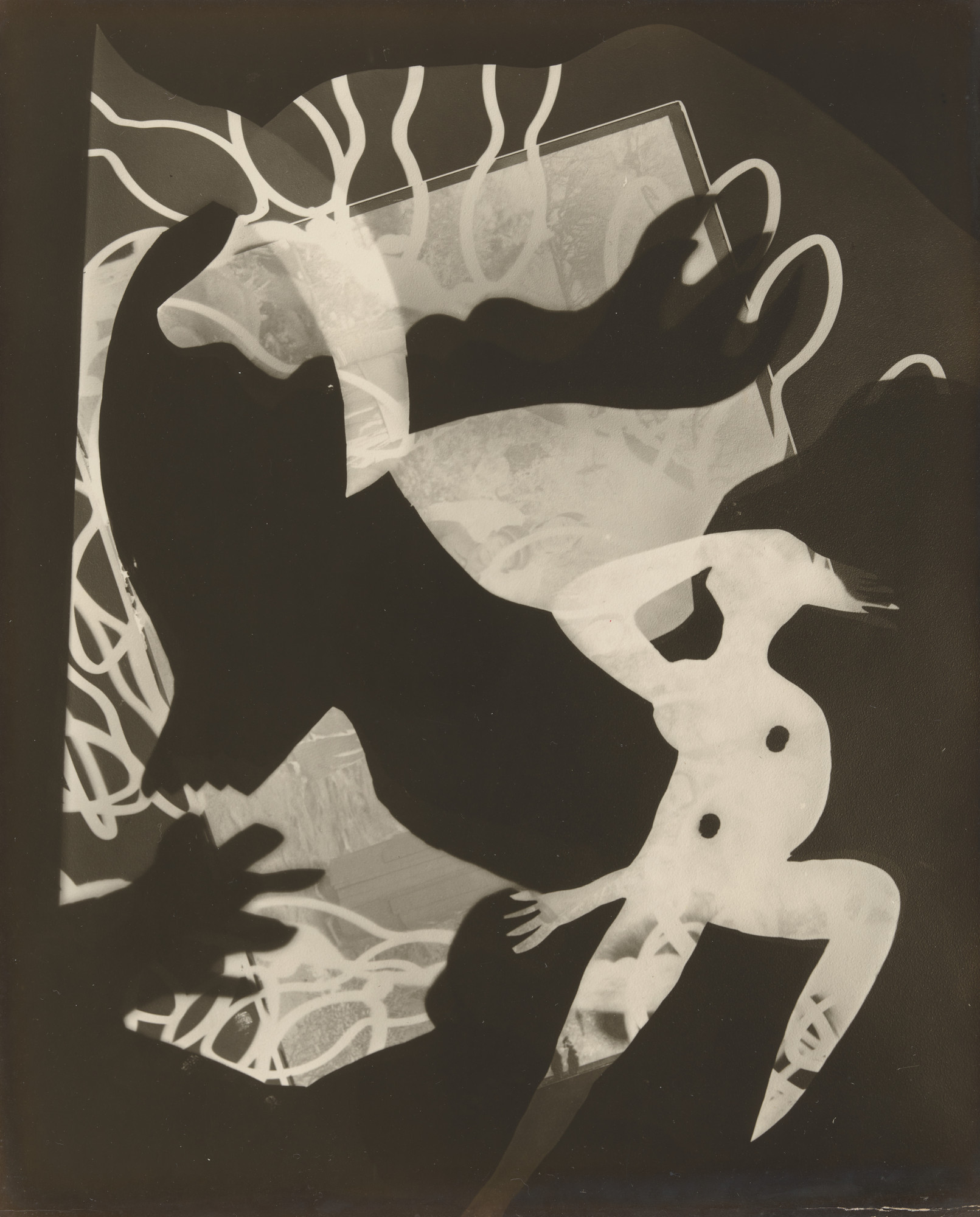
Curator, Caitlin Ryan: Though originally trained as a painter, in 1930, Ei-Q enrolled in a photography course where he made his first photograms, which were some of the first realized in Japan. Ei-Q immediately saw a parallel between the two mediums, and in the way that light could be used like paint.
A photogram is a type of photographic image made without a camera or a lens. Instead, an image is created by placing objects directly onto light-sensitive photographic paper and then exposing it to light. The areas where the objects block the light appear lighter, while the exposed areas turn dark. The result is a silhouette or a shadow-like image of the object.
Ei-Q specifically used lace, mesh, wires, springs. He also sketched figures onto cardboard, which he cut out and arranged. You'll see these moments where he's moving the objects slightly as he's making these exposures, so that they feel like they're blurring in and out of focus.
In 1936, he decided to publish this work as a portfolio, which he called Reason of Sleep, and so he's thinking about these ideas of the unconscious, that dreams could tell about these things that are beneath reality. It does feel like that kind of moment of opening your eyes or a dream fading as you wake up.