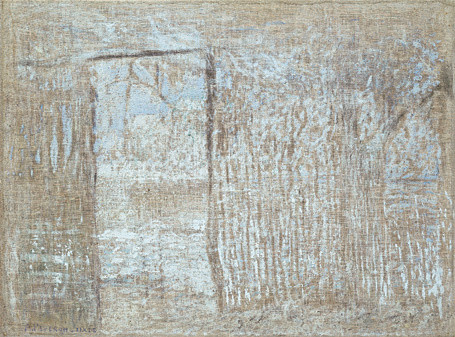
John Elderfield: In 1921 Reverón moved to Macuto, a small village on the Caribbean coast, and there he began to build a compound for himself and the woman who he was living with, Juanita Ríos. Light Behind My Arbor is painted from inside one of the little huts inside this compound, El Castillete, the little castle.
As with the other landscapes of this period, he’s trying to provide the sense of what very strong Caribbean light is like, how it has the effect of blurring the perception of things, so it is hard to see the separate identities and forms. We know in fact that this hut was screened by fabric, and one is actually looking through the fabric to hazy landscape. One can see forms of trees, but it’s very hard to firmly identify everything.
Reverón is clearly trying to make one very aware of the marked surface of the composition. And the coarse canvas itself provided a sense for him of how the strokes would be carried through the picture. A lot of the marks run horizontally, a lot of them run vertically, a bit like a weaving. Some of the tree marks are actually the bare canvas which is showing through the white paint.
In terms of him recording the effects of light, he’s been related back to the Impressionist tradition. In terms of his making one very much aware of the marked surface, to later abstract artists who have made monochrome paintings.
Reverón was first celebrated for these so-called “white landscapes,” and in Venezuela became presented as a prophet of abstraction. But in fact they are very distinctive responses to a landscape which is viewed.